Autumn Leaf Litter: A Field Guide to What It Tells You
The floor of a wood in late October is not a mess. It is a set of notes left by everything above it. Walk a lane after the first hard wind and you can name the trees overhead without lifting your head: pale papery beech, leathery oak with its lobes still folded, the leaflets of ash lying greenish in the gutter. Walk a few metres further and the same litter starts telling you about water, worms, fungi and time. All it asks is that you kneel down once in a while and get your knees damp.
Start With the Shape of the Leaf
The first thing a drift gives you is a species list. Not a tidy one — a mixed drift is a jumble of shapes, some of them half rotted and stuck together — but a reliable one if you look at the edges as well as the outline.
- Beech and hornbeam. Oval leaves with wavy or finely toothed margins, turning a pale biscuit brown. Beech often keeps its leaves on the tree through winter, especially on young trees and hedges, so a drift of beech under a bare canopy can be weeks older than it looks.
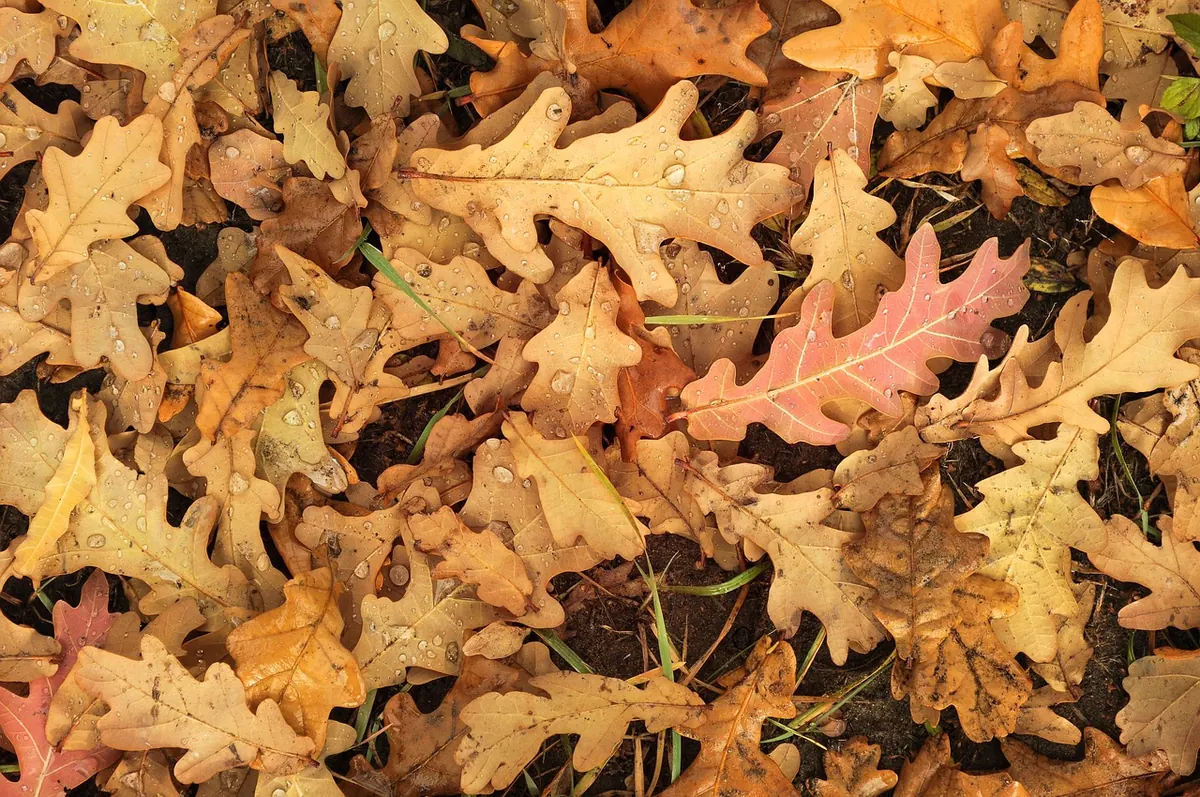
- Oak. Deep-lobed and stiff. Oak leaves curl and crackle rather than lie flat, and they tend to stay on the surface longer than anything else around them.
- Ash. A leaf made of seven to thirteen leaflets, often dropping while still green or yellow-green. Ash is usually an early dropper, so finding fresh ash litter tells you the season has turned even if the weather has not.
- Alder and willow. Rounded leaves with a notched tip, or long narrow ones. Both point you towards damp ground, ditch lines and the edges of streams.
- Sycamore. Broad, hand-shaped leaves, often in thick drifts along tracks and gateways. They rot quickly and flatten into a wet mat that smothers what is underneath.
- Larch needles. Not leaves in the broad sense, but worth knowing: a larch is a conifer that sheds, and its needles fall in a soft golden shower that mats into a dense, springy carpet.
One leaf is a clue. Fifty leaves in one place is a description of the soil. A drift of oak and beech on a dry ridge is a very different place from a drift of alder and willow in a hollow that holds water until May.
Slow Leaves, Fast Leaves: Reading Decay
Leaves are not all built the same way, and the difference shows in how long they last on the ground. Oak and beech are tough, rich in tannins and lignin, and slow to break down; a beech leaf can still be recognisable the following spring. Ash, alder, birch and sycamore are softer, hold more nitrogen, and can be reduced to a dark skeleton of veins within a few weeks of wet weather.
This is why a mixed wood floor is layered. The fast leaves have already gone into the soil, the slow ones are still sitting on top, and somewhere in between is a crumbly brown horizon that smells of mushrooms and damp cardboard. Push your fingers into it and you are touching the part of the forest that does the actual work.
Worms make the difference
Where earthworms are abundant, leaf litter disappears from the surface quickly — pulled down, mixed with mineral soil, recycled. Where the ground is acid and the worm population is thin, dead leaves pile up into a raw, matted layer that builds year on year. If you find yourself walking on a thick, spongy mat of intact leaves with fungal threads through it, you are almost certainly on acid ground, and the plants around you will agree: bilberry, heather, hard fern, moss.
What the Litter Says About Water
Leaves are light, and water moves them. After heavy rain, litter collects in drift lines along the downhill side of logs, against fence lines, at the break of a slope, in the shallow channel where a path drains. Those lines are a map of how water crosses the site.
Look for hollows where leaves are dark, matted and pressed flat, with a slick of silt underneath. That is a place that fills. Look for leaves lying loose and dry on a slope even after a week of rain, and you have found ground that sheds water fast — sand, gravel, thin soil over rock. A drift of leaves that never seems to rot, sitting on a wet-looking surface, usually means the ground is waterlogged and airless rather than merely damp; be prepared for boggy footing and choose your steps.
Some plants read the same signals: rushes, sedges and mosses in the hollows, dog's mercury and ferns on the flushed slopes, bracken on the dry shoulders. Put the leaf drift and the ground flora together and you have a decent drainage sketch of the whole wood, without digging a hole. The litter itself matters too — a good layer of leaves slows runoff, traps seed and keeps the soil surface from being scoured by rain.
Fungi, Veins and the Skeleton Stage
Watch a single leaf over a winter and you will see the sequence. Fresh and whole, then blotched with pale spots, then holed, then reduced to a pale tracery of veins. Veins are stiff with lignin, so they outlast the soft tissue between them. The lace you find in February is a leaf that has been eaten from the inside.
That eating is mostly fungal. Lift the top layer in mild, wet weather and you will see white threads binding leaves together, and sometimes the small fruiting bodies of the fungi behind them. Two kinds of decay are worth learning to recognise:
- White rot turns wood and tough litter pale and fibrous, leaving a stringy residue.
- Brown rot leaves material dark and brittle, cracking into small cubes as it dries.
Also note the larger signs: brackets on standing dead trunks, jelly fungi on fallen branches, and rings of toadstools in the grass at the wood edge, where the litter layer thins out. Treat everything you find as something to look at rather than something to eat. Identification for the table needs an expert and a good field guide, and a photograph on a phone is not either of those.
The Clock of the Season
Autumn colour is a subtraction, not an addition. As chlorophyll breaks down, the yellows and oranges that were there all along become visible; the reds in some species come from pigments formed as sugars are trapped in the leaf before it drops. That is why a cold, bright autumn can look so different from a wet, grey one.
Timing is just as readable. Ash goes early, often still half green. Oak holds on. Beech and hornbeam tighten their grip on the leaf and let go late, sometimes not at all until spring pushes the new buds off. A tree shedding heavily in August is usually not confused about the calendar — dry soil is the more likely reason. If you walk the same path every week through October and November, you will start to notice that the order of falling barely changes from year to year, and that the exceptions are interesting.
Small Lives Under the Top Layer
The top few centimetres of leaf litter is the warmest, dampest, best-insulated place in a wood, and a great many animals spend the winter in it. Woodlice, millipedes, springtails and ground beetles are the visible ones; slugs and spiders work the layers below. Queen bumblebees, hedgehogs, frogs and slow-worms use deeper piles and the hollows under logs.
The practical consequence is simple. Lift a pile to see what is there, then put it back as you found it. Avoid walking repeatedly over deep drifts at the base of trees, and never tidy a woodland floor the way you would tidy a garden — the leaves are the next decade of soil.
A Short Field Routine
If you want to turn this into a habit, keep it small and repeatable.
- Pick one stretch of path, no more than a hundred metres, and walk it once a fortnight through autumn.
- Stop where litter has gathered against an obstacle. Note the two or three commonest leaf shapes and roughly how rotted they are.
- Check the drift for water lines: silt, dark matted leaves, a wet hollow. Note where the ground squelches.
- Lift the top layer in a mild spell and look for white threads, pale skeletons and small animals. Put everything back.
- Write three lines in a notebook: date, what is falling, what the floor is doing. A phone note is fine.
- Compare the same spot the following year. One year tells you about the weather; three years start telling you about the wood.
Nothing here needs equipment beyond boots and a little patience. The forest floor is the most accessible record in the wood — it is already open, already written, and it rewrites itself every autumn.
Photo: Larisa-K / Pixabay

How to Season Fallen Wood for Simple Woodland Crafts
A fallen branch can become a spoon, a hook or a walking stick, but only if it dries slowly and properly....
Windbreaks and Woodland Edges: How Trees Shape Local Weather
Tree lines and forest edges slow wind, hold moisture and cool the air nearby. Here is how to read those...