
How to Identify Six Common Woodland Tree Leaves
Halfway down a shaded track, someone stops, picks up a leaf and turns it over twice. Most of the time the answer is already in their hand: a rounded lobe, a row of fine teeth, a leaflet sitting opposite its partner. Reading woodland trees from their leaves is less about memorising species than about learning what to look at first.
Almost every broadleaf you meet in a European wood narrows down with four clues: the outline (shape), the margin (smooth, toothed or lobed), the arrangement (alternate or in opposite pairs up the twig) and the surface — glossy or dull, hairy or bare, and what the underside does when you hold it up to the light. Get those four in order and the six trees below stop looking alike.
Oak: deep lobes, crowded at the shoot tip
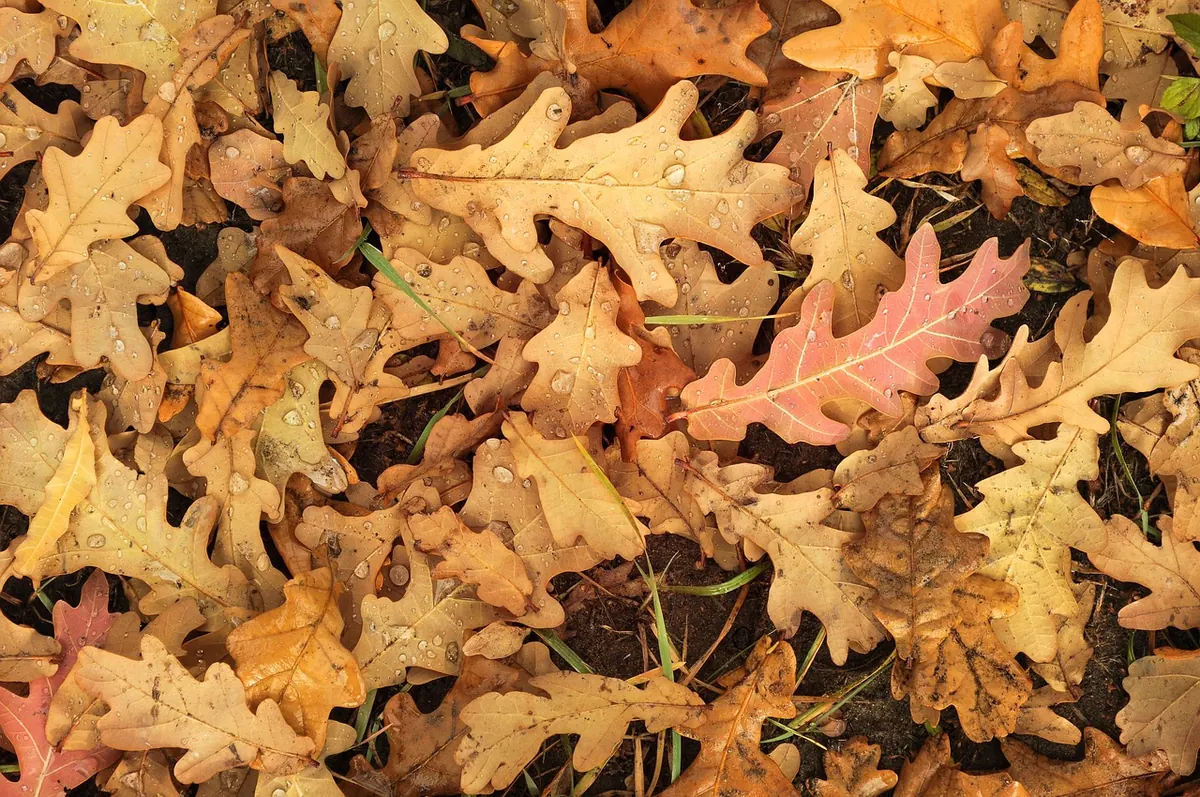
Oak is the leaf most people recognise without quite knowing why. The outline is a set of rounded fingers — deep lobes that cut in towards the midrib but never reach it — and the whole blade is leathery, darker above and noticeably paler beneath. The two sides rarely match, and that irregularity is itself a clue, since most other leaves are neatly symmetrical.
Arrangement matters here. Oak leaves are alternate, but they crowd together in a loose rosette at the end of each shoot, so you tend to find five or six overlapping rather than evenly spaced along the twig. Crush one and the smell is faintly tannic, like old tea.
Two oaks, two outlines
Most native oaks in European woods carry rounded lobes. Red oak, planted widely and spilling out of parks, has pointed lobes tipped with a tiny bristle — run a finger along the edge and a prick tells you it is an introduced tree. One piece of trivia worth carrying: pedunculate oak, the great hedgerow tree, hangs its acorns on long stalks while its leaf stalks are almost nonexistent. Sessile oak reverses both. The names describe the acorns, not the leaves.
Beech: an unbroken edge with a silky fringe
Beech leaves are oval, five to ten centimetres long, and almost impossibly tidy. The margin has no teeth at all — a clean, slightly wavy line from stalk to tip — but look closely at a young leaf in spring and you will find a fringe of fine white hairs along that edge, like an eyelash.
The veins give it away. Five to nine pairs run straight and parallel from the midrib to the margin, pressing the leaf into shallow corrugations. Hold it against the sky and the pattern is unmistakable. Beech leaves are alternate and lie flat in two ranks, catching light like roof tiles, which is why a beech canopy looks so solid from underneath. On young trees and low hedges the dead copper leaves often stay attached through winter, so you can name a beech in January when almost everything else is bare.
Sweet chestnut: long, glossy and sharply toothed
Sweet chestnut announces itself by size. Leaves run 12 to 20 centimetres, narrow and spear-shaped, glossy dark green, with a row of sharp teeth down each side that curve towards the tip rather than jutting straight out. The veins are deep and parallel, giving a ridged, quilted surface.
What separates it from beech is the combination of teeth and length. Beech has no teeth and rarely passes ten centimetres. Chestnut leaves also spiral around the shoot instead of lying flat in two ranks, and they have almost no stalk, so the blade looks pinned directly to the twig. In autumn they turn a buttery yellow before anything else in the wood.
Hazel: round, soft and doubly toothed
Hazel leaves are broad and nearly circular, with a heart-shaped base and a short, sudden point. They feel soft and slightly rough, like flannel, and the veins underneath carry fine hairs. The edge is doubly toothed: a larger tooth with a smaller one tucked between each pair. Once you have noticed that, you will start seeing it everywhere.
The arrangement is a neat detail worth checking. Hazel leaves are alternate, but each pair sits at right angles to the last, so they spread in two flat ranks and waste very little light. Spring leaves are thinner and brighter than the summer version, sometimes almost translucent. You may find nuts later in the year, but do not lean on them alone — hazel sits in the birch family, whose members share that rounded, toothed template.
Ash: one leaf, many leaflets
Ash is the tree that trips people up, because what falls to the ground in October is not a leaf but a leaflet. A single ash leaf can reach 30 centimetres and is made of seven to thirteen oval leaflets set in opposite pairs along a central stem, usually finishing with one leaflet at the tip.
The opposite-pairs test
Here is the check that settles it. Pick a twig, not a leaf, and look at how the leaves join it. Ash is opposite: two leaves spring from the same point, one on each side, pair after pair up the stem. Oak, beech, chestnut and hazel are all alternate, one leaf per node, stepping or spiralling around the twig. If the leaflets are opposite and the leaves are opposite, you are looking at ash or elder — and elder is a soft-stemmed shrub with sharply serrated leaflets and a heavy, sour smell when crushed.
Hawthorn: small, glossy and cut into lobes
Hawthorn leaves are small, two to six centimetres, and deeply cut into three to seven lobes, with a wedge-shaped base narrowing to the stalk. They are dark and glossy above, only slightly paler beneath, and they grow in bunches on short spurs rather than spaced along the twig, so a hawthorn branch looks slightly tufted.
The lobes separate hawthorn from oak at a glance. Oak lobes are rounded, the leaf large and leathery; hawthorn lobes are shallower and sharper, the leaf thin and small enough to sit on a thumbnail. Midland hawthorn is less deeply cut — sometimes barely lobed at all — which is where the spines on the shoot and the clusters of red haws in autumn confirm what the leaf is suggesting.
Habits that make the next walk easier
The sharpest field botanists are not walking encyclopaedias. They simply check the same things in the same order, every time, and they are honest when a leaf is ambiguous. Take one leaf from a low branch, one from a shaded side of the same tree, and compare them: sun and shade leaves of a single oak can differ enough to fool you.
- Shape: oval, round, spear-shaped or lobed. Trace the outline in the air with a finger; it fixes the shape in memory better than a photograph.
- Edge: smooth, toothed, doubly toothed or lobed. A cheap hand lens turns a guess into an answer.
- Arrangement: alternate or opposite. Always check the twig, never the single leaf in your palm.
- <
Photo: uniquedesign52 / Pixabay

How to Season Fallen Wood for Simple Woodland Crafts
A fallen branch can become a spoon, a hook or a walking stick, but only if it dries slowly and properly....
Autumn Leaf Litter: A Field Guide to What It Tells You
What fallen leaves reveal about tree species, soil moisture, fungal decay and the turning season — plus a...